Post series: why RF module designers choose COTS over custom
Drafted 2026-10-12. COTS = "commercial off-the-shelf": parts you buy from a catalogue (a Skyworks LNA, a MACOM mixer) instead of designing your own chip or circuit.
Checked first: posted-log.md has no COTS post yet, so this is a new topic.
The series (3 LinkedIn posts, one a week, plus one Reddit post)
Reordered 2026-10-12 at the owner's ask: the series now OPENS with the owner's own point (RF engineers use COTS most of the time, and the trend is growing), then shows the hard part, then the counterpoint.
| # | Date | Post | Folder in Documents\MagicON-posts\ |
|---|---|---|---|
| 1 | Wed 2026-10-21 | "Why most RF modules are built from COTS" (with growth chart) | cots-series-1-why-cots |
| 1R | Wed 2026-10-21 | Same topic for Reddit (discussion, no promotion) | cots-series-1-reddit |
| 2 | Wed 2026-10-28 | "The hard part of COTS is choosing" (real MagicON run, with image) | cots-series-2-choosing |
| 3 | Wed 2026-11-04 | "When custom still wins" | cots-series-3-when-custom-wins |
A one-time desktop reminder fires at 9:00 on each date (cots-post-1-reminder … -3-reminder)
and checks this log first. Wednesdays avoid the puzzle rhythm (puzzle Monday, answer Friday).
Before posting each one: check posted-log.md, then add a row with the live link.
Post 1: "Why most RF modules are built from COTS" (Wed 2026-10-21)
The owner's point: RF engineers use COTS most of the time, it is a growing trend, and COTS is easy to design in, predictable, cheaper to build with, and reliable. No RF figures in it.
Wording choices, and why:
- "Reliable" became "proven". Space-industry sources say COTS parts must be "up-screened"
(tested further) to match the reliability of radiation-hardened parts, so "more reliable" as a
blanket claim can be challenged. "Proven in volume production" is true and hard to argue with.
- "Growing trend" is backed by two sourced facts, not a market number: the 1994 Perry memo
that moved US defence buying toward commercial specifications, and small-satellite makers now
seeing COTS as the current direction. No source found that measures the trend for RF parts
specifically, so the RF part is written as the author's own experience ("most modules I see").
Sources: Government Executive, Feb 1996
("A decision was made in 1994 to move to off-the-shelf commercial products … whenever possible"),
DTIC report on the Perry memo (site down
for maintenance on 2026-10-12),
COTS in NewSpace (Politecnico di Bari).
More, each opened and checked 2026-10-12:
Microwave Journal, Oct 2022
(NASA's NESC study: high-volume parts from a trusted supplier "are likely to be extremely
reliable"; new-space companies adopted COTS for LEO),
Microwaves & RF, Feb 2022
(RF-specific: defence primes with their own GaN/GaAs foundries still rely on many sources for
RFICs and MMICs), and the
NASA Small Spacecraft knowledge base (the
traditional parts approach is "inappropriate (and in many cases impossible)" for smallsats).
Added at the owner's ask:
Straits Research, satellite COTS components market
(updated 2026-08-24). ⛔ Do NOT quote its numbers: the page calls the growth "strong" but gives
a global CAGR of 1.2% (USD 2,021.05 million in 2025), and in the same list puts the US market
alone at USD 6.4 billion, about three times the global figure. Fine as a "market reports growth"
pointer, nothing more.
SOSA line (added 2026-10-12):
The Open Group, SOSA Consortium — "empowers government and
industry to collaboratively develop open standards" for sensors and C5ISR payloads, aiming at
"rapid fielding of cost-effective capabilities" from "common components". Building MagicON
support for SOSA is a separate idea, logged on issue 474.
Also added at the owner's ask:
Strategic Market Research, semiconductors in military and aerospace
(USD 9.6 billion in 2024 to USD 15.5 billion by 2030, 8.4% a year; RF semiconductors "witnessing
strong momentum"). ⚠ It covers ALL military/aerospace chips, not COTS, and says such chips "often
involve custom design and long design cycles" — the opposite of the post's point. Use it only for
"defence RF chips are a growing market", never as evidence for the COTS trend.
- One line on where custom still wins stays in, because senior RF engineers will say it in
the comments if the post doesn't. Post 3 expands it.
- The post ends on "which COTS parts?", which is the hook for Post 2.
- Image: cots-series-trend.png (built by
docs/scripts/make-cots-series-trend.py). Bars = Visiongain, Jul 2026
military communications & COTS market: US$42.90 billion in 2026, US$75.70 billion by 2036,
5.8% a year (opened 2026-10-12; figures agree with each other). Only the two stated values are
drawn, 2036 hatched as a forecast. Timeline: 1994 and the 2020 NASA study. Straits Research and
Strategic Market Research are deliberately NOT plotted (reasons below).
- PDF attachment (decided 2026-10-12): the owner's Muse report "COTS usage trends in RF
modules" goes with this post as a PDF, after the fixes listed in
cots-muse-report-check.md. Not the Muse link: it opened Muse's login
page for a signed-out browser. ⚠ Not verified: whether LinkedIn lets one post carry both an image
and a PDF. If it doesn't, the PDF replaces the trend image.
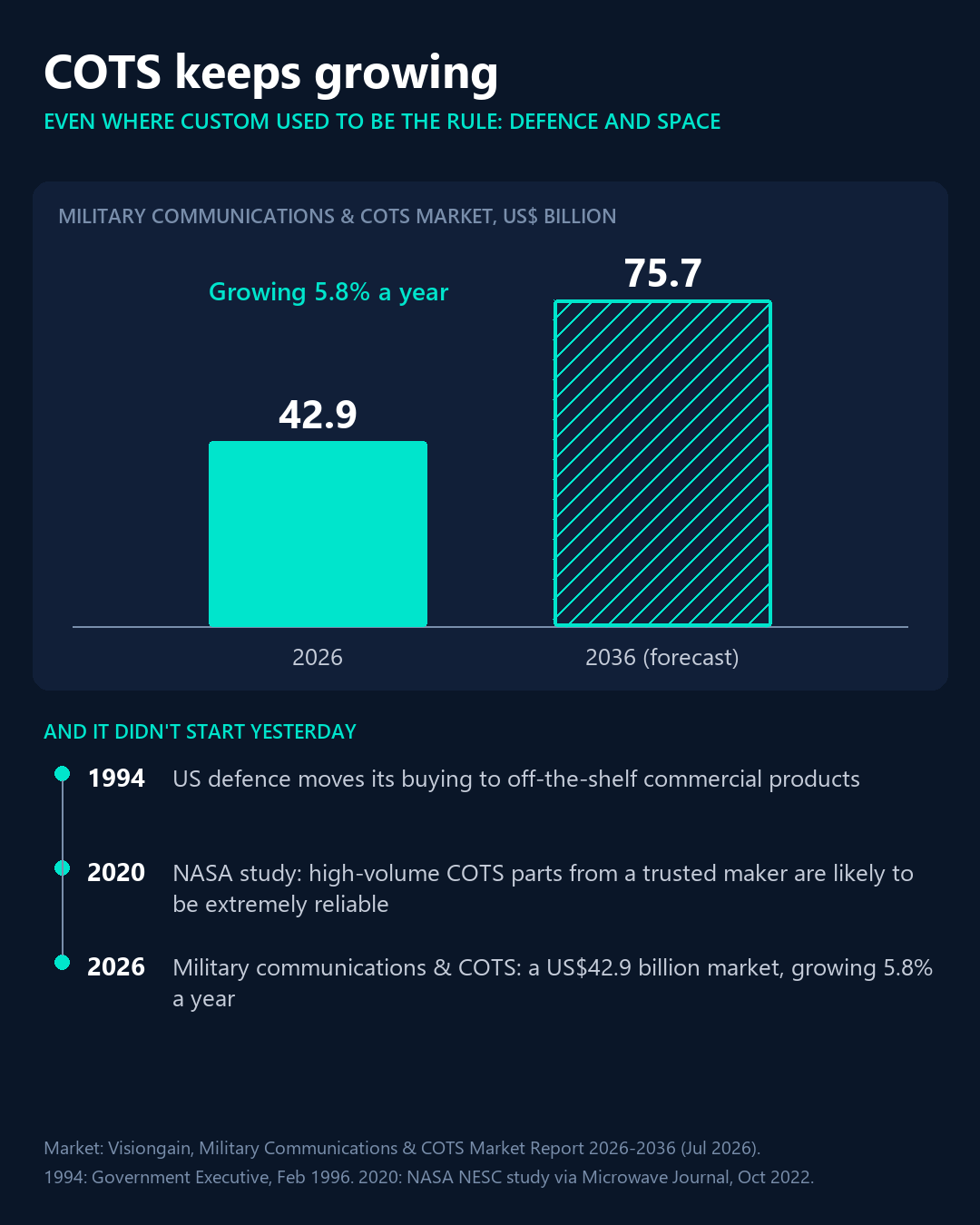
Most RF modules I see today are built from off-the-shelf parts. Not because engineers forgot how to design an amplifier, but because COTS (commercial off-the-shelf) parts win on what matters in a product:
✅ Easy to design in. Datasheets, S-parameter files, evaluation boards and reference layouts exist before you draw the first trace. ✅ Predictable. Gain, noise figure and compression point were measured on real parts, under stated conditions. A custom circuit's numbers are a simulation until the first boards come back. ✅ Proven. The parts have already shipped in volume, with qualification data behind them. Even NASA concluded that high-volume parts from a trusted maker are likely to be extremely reliable. ✅ Cheaper to build. No one-time cost for masks, test fixtures and re-spins. ✅ Faster. You choose parts instead of designing them and waiting for silicon.
And the trend keeps growing. US defence moved its buying toward commercial specifications back in 1994. Today government and industry write open standards like SOSA together, so defence sensors can be fielded faster and at lower cost from common, swappable modules. Even small-satellite makers see COTS as the way forward, and add extra screening where they need it. Forecasts for nearby RF markets point the same way: Yole expects the RF GaN market to grow about 11% a year to 2031.
Custom still has its place: extreme size or power limits, very high volume, or a job no catalogue part can do. But for most modules, the question has changed from "should we use COTS?" to "which COTS parts?"
That second question is the one I built MagicON around, and it's harder than it looks:
🔹 You can't vibe-code it. In a weekend, an AI can build you a chat window that talks about RF. What it can't build is what sits behind the answers: • a catalogue of thousands of real parts, with their makers' specs and test conditions • solvers pinned to fixed reference results, so any change that moves a number gets caught • checks learned the hard way, like flagging a bare-die part that can't go through normal reflow, or a filter spec with no frequency attached That takes slow, careful work, not a prompt. 🔹 It doesn't make numbers up. Every figure comes from a solver, and when no part fits a slot, it says so instead of inventing one. Asked for the same PCB stackup, an AI on its own gave me seven different answers. MagicON gave the same one all four times. 🔹 It works inside the AI tools you already use. It runs as an MCP server, so any assistant that supports MCP can call it, with no account and no API key. A built-in checker flags any figure in the assistant's answer that no solver produced.
My reading notes on where the market is heading, with sources, are in the PDF below.
Do you still design any part of your RF chain from scratch? What made it worth it?
RFDesign #RFEngineering #HardwareDesign #COTS #MCP
First comment: the install line from block 1:
claude mcp add --transport http magicon https://api.pcbgenerator.com/mcp/
Where the three MagicON lines come from (added 2026-10-12 at the owner's ask: "not vibe-codable,
no hallucinations, works with MCP"):
- "Thousands of real parts": 3,122 part records in 19 category folders of
backend/categorized_databases/, counted on 2026-10-12 at main d0be784d8. The post says
"thousands" because the live server's copy was not counted.
- "Solvers checked against fixed reference results": the engines are pinned by frozen golden
files and parity tests (CLAUDE.md, e.g. tools/gen_receiver_parity.py, test_link_budget_parity.py).
- "Seven different answers … same one all four times": the stackup A/B test already posted on
2026-10-05 (marketing-block-1.md). Of the seven, only three were fresh
test runs, so the post says "answers", not "runs", as block 1 did.
- "Doesn't make numbers up" is about MagicON's own figures, NOT the assistant's text. The
assistant can still write a wrong number; that's why the post names the checker
(check_grounding) instead of claiming "no hallucinations". Never shorten it to "zero
hallucinations": the checker is not perfect (it misread a part number as a power figure,
issue 477).
- "No account and no API key": as stated in the block 1 post.
- The two "checks learned the hard way" are the two warnings the 2026-10-12 receiver run
printed (Post 2). ⛔ Do NOT use "won't pick a 20 W power filter where the signal is microwatts"
as an example: that same run picked RLF0250A (the 20 W filter CLAUDE.md describes) for the IF
slot, ranked on its low loss, so the claim would be contradicted by our own result.
- 2,896 characters with the PDF, Yole and SOSA-cost lines (counted on the paste-ready
post-1.txt, 2026-10-12), under LinkedIn's 3,000 limit.
- Yole line (added 2026-10-12): RF GaN market about $1.3B (2025) to $2.4B (2031), 11% a year,
per Compound Semiconductor.
It is the whole RF GaN market, not COTS; the post says "nearby RF markets" for that reason.
⛔ Do NOT write "adjacent RF segments grow 6–13%": its low end is IndexBox (a content-marketing
estimate) and its high end Mordor's broad front-end market (not checked).
- "Faster and at lower cost" (added 2026-10-12): rests on the SOSA page's "rapid fielding of
cost-effective capabilities" quoted above.
Post 1R: the Reddit version (Wed 2026-10-21)
For a subreddit such as r/rfelectronics. Reddit readers dislike ads, so this version asks a real question and does not mention MagicON. If someone asks what you use, answer in a comment and say you built it. ⚠ The subreddit's self-promotion rules were not checked: read its rules page before posting.
Title: Do you still design any RF blocks from scratch, or is it all COTS now?
In most RF modules I've seen lately, almost every block is an off-the-shelf part: LNA, mixer, PLL, filters, step attenuator. The reasons seem obvious once you list them:
- Easy to design in: datasheets, S-parameter files, eval boards and reference layouts already exist.
- Predictable: gain, NF and P1dB were measured on real parts under stated conditions, not simulated.
- Proven: the parts have shipped in volume with qualification data.
- Cheaper to build: no masks, fixtures or re-spins.
- Faster: you pick parts instead of waiting for silicon.
Even defence (since the 1994 Perry memo) and small satellites have moved toward COTS, with extra screening where needed.
Custom still seems to win for extreme size/weight/power, very high volume, or when no catalogue part does the job.
Curious where people here draw the line. What's the last block you designed yourself instead of buying, and was it worth it?
Post 2: "The hard part of COTS is choosing" (Wed 2026-10-28)
Proof run: MagicON design_rf_receiver, 2026-10-12, inputs: 5.8 GHz, 20 MHz noise bandwidth,
application drones, full superheterodyne. Result: 8 of 8 slots filled, needsPartFlags: [],
cascaded NF 1.19 dB, parts from 6 makers (Mini-Circuits, Skyworks, CTS, MACOM, Texas Instruments,
Analog Devices). The two "check yourself" points below are quoted from the tool's own warnings.
Draft passed check_grounding (0 findings).
The link that opens this design in the app expires on 2026-10-19, before this post, so the post does not use it.
⚠ The post deliberately does not name the IF filter the tool picked (RLF0250A, a lowpass part). It is a valid pick, but not one to show off.
Image: cots-series-post-1.png (built by
docs/scripts/make-cots-series-post-1.py; the file name keeps its first number, the post moved).
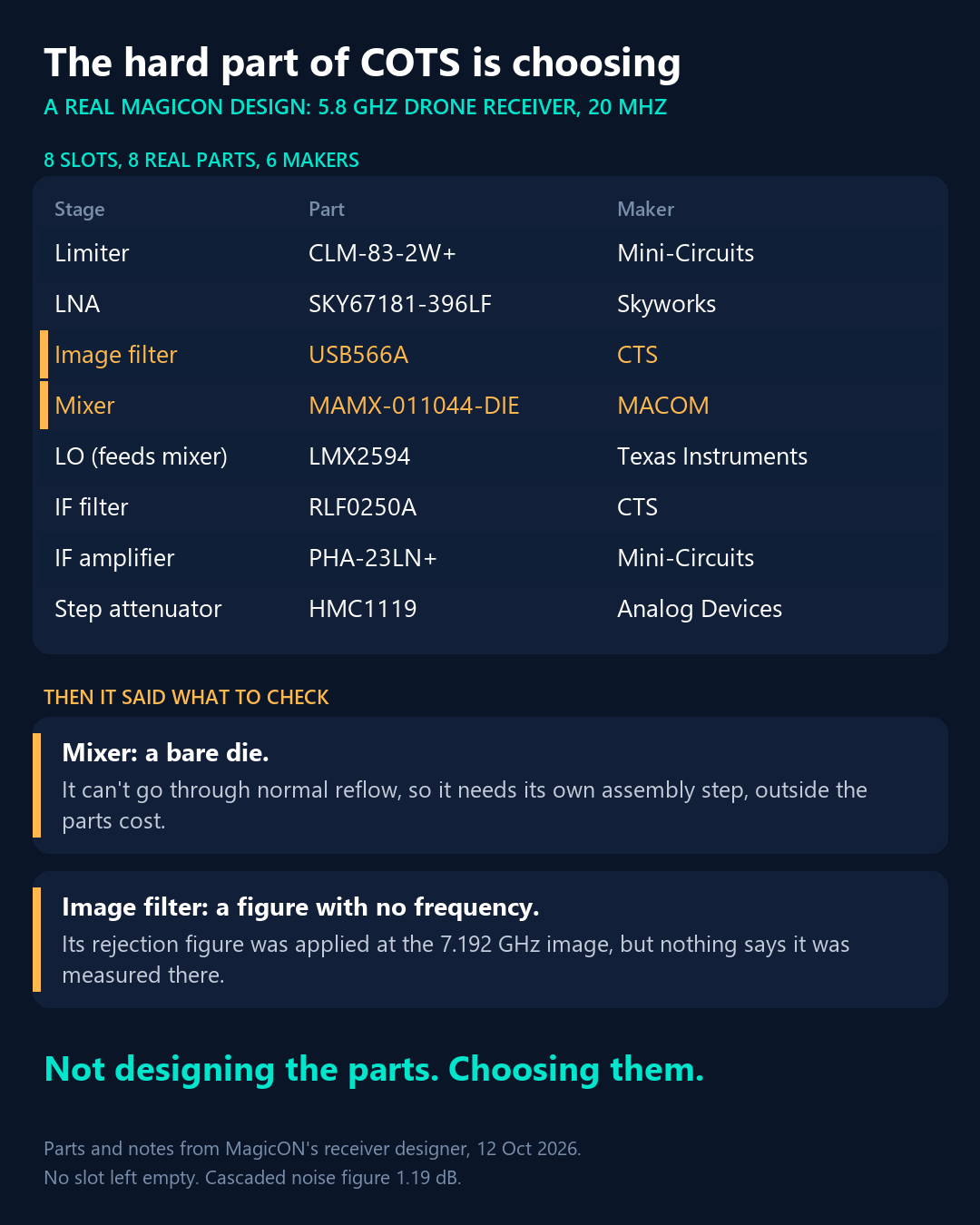
Last week I wrote that most RF modules are now built from off-the-shelf parts. Here's the part nobody mentions: how long it takes to choose them.
I asked MagicON to design a 5.8 GHz receiver for a drone link, 20 MHz bandwidth, using only real catalogue parts.
It filled all 8 slots (limiter, LNA, image filter, mixer, LO, IF filter, IF amp, step attenuator) with parts from 6 different makers. Cascaded noise figure: 1.19 dB. No empty slots.
Then it listed what I would still have to check myself: 🔸 The mixer it picked (MAMX-011044-DIE) is a bare die. It can't go through normal reflow, so it needs a separate assembly step that the parts cost doesn't cover. 🔸 The image filter's rejection figure (USB566A) has no frequency attached in its record. The tool applied it at the image frequency, 7.192 GHz, but nothing says it was measured there.
Neither is a reason to drop the part. Both are the kind of thing you find after the board is built if nobody writes them down.
That's the real cost of COTS. Not designing the parts: choosing them. Every part is a datasheet, a set of test conditions and a footnote.
What's the worst datasheet surprise you found only after the board was built?
RFDesign #RFEngineering #HardwareDesign #COTS #MCP
First comment: the install line from block 1:
claude mcp add --transport http magicon https://api.pcbgenerator.com/mcp/
Post 3: "When custom still wins" (Wed 2026-11-04)
No figures in this one. The MagicON line rests on the tool's own description: a slot no part can
fill is reported in needsPartFlags instead of being filled with an invented part.
Two weeks of arguing for COTS. Here's when I'd go the other way.
🔹 Size, weight and power ARE the spec. When one channel is repeated hundreds of times, as in a phased-array tile, integrating it pays back. 🔹 You're past the edge of the catalogue. No part exists at your frequency and power together. 🔹 Volume. The one-time design cost gets spread over enough units to make sense. 🔹 Control. Export rules, or a programme that has to run longer than a part's production life.
There's a middle path too: COTS to prove the design, then custom only for the parts that matter.
When MagicON can't fill a slot from real parts, it says so instead of inventing one. That empty slot is often exactly where a custom design starts.
Where did you draw the line on your last project?
RFDesign #RFEngineering #HardwareDesign #MMIC #COTS
Ideas not used
- "A datasheet is a promise. A custom design is a prediction." Dropped 2026-10-12: Post 1's
"Predictable" line now covers it. Its paste-ready text is kept in
Documents\MagicON-posts\_unused\cots-datasheet-promise\. - The volume math: at what volume does custom start to pay off? Only with a real, citable crossover figure.
- End-of-life risk: with COTS you don't own the part; check second sources at design time.
- Poll/puzzle: give a short spec and ask "COTS or custom? Why?"